An AI homework assistant for students is a digital learning tool that uses AI to help students understand questions, explain concepts, organize study tasks, review writing, and practice problem-solving. It can support homework, but it should not replace a student’s own thinking, teacher guidance, or academic responsibility.
For Canadian students, AI homework assistants are becoming part of everyday learning. Many students use them to get unstuck, understand assignments, check grammar, review math steps, or prepare for tests. At the same time, schools and parents are asking important questions: Does AI actually help students learn? Can it be inaccurate? Is it cheating? How can students use it responsibly?
This guide explains the benefits and limitations of AI homework assistants so students can use them as learning support rather than as a shortcut.
What Is an AI Homework Assistant for Students?
An AI homework assistant is a tool that helps students with schoolwork by giving explanations, examples, feedback, study guidance, and step-by-step support. It may help with subjects such as math, science, English, history, writing, reading comprehension, and test preparation.
A good AI homework assistant can:
- Explain a difficult concept in simpler words
- Break a problem into steps
- Help plan an essay or assignment
- Suggest practice questions
- Review grammar and sentence clarity
- Summarize study notes
- Help students understand where they made a mistake
However, an AI homework assistant is not the same as a teacher. It cannot fully understand a student’s classroom context, grading rubric, teacher expectations, emotional needs, or learning history.
Why Canadian Students Are Using AI Homework Helpers?
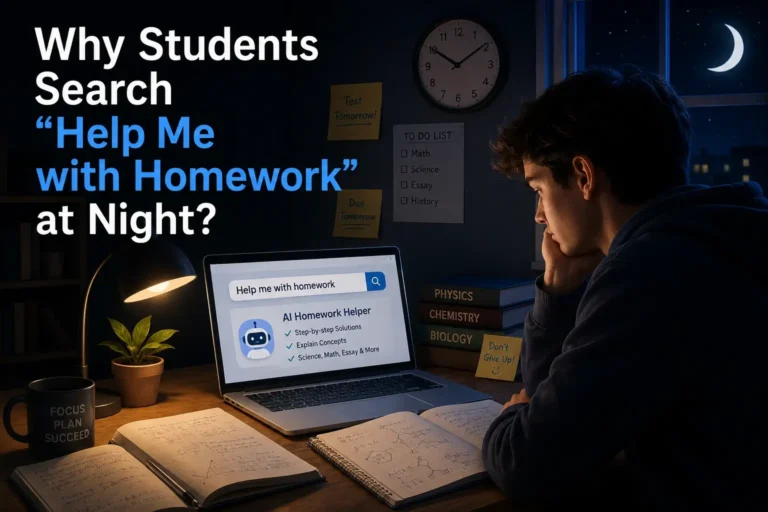
Canadian students use AI homework tools for faster support, clearer explanations, and help outside school hours. Homework questions often come up in the evening, on weekends, or close to deadlines, when a teacher may not be available.
Recent Canadian survey data show that students’ use of generative AI for schoolwork has grown rapidly. KPMG in Canada reported that 73% of Canadian students used generative AI for schoolwork in 2025, up from 59% in 2024 and 52% in 2023. The same report also raised concerns about critical thinking, knowledge retention, and students’ uncertainty about whether AI use counts as cheating.
That means the question is no longer only “Should students use AI?” A better question is:
How can students use AI homework assistants in a way that supports real learning?
Key Benefits of AI Homework Assistants
AI homework assistants can be helpful when students use them with purpose. They are most useful when they explain, guide, check, and practice, not when they produce final answers.
They Give Step-by-Step Explanations
One of the biggest benefits of an AI homework assistant for students is step-by-step support. Instead of showing only the final answer, a helpful AI tool can explain how to arrive at it.
For example, in math, a student may ask:
“Can you explain how to solve this equation step by step?”
A good AI homework helper should show each step and explain why it matters. This helps the student understand the process instead of memorizing the answer.
They Help Students Get Unstuck
Students often stop working because they do not know how to start. An AI homework assistant can help by breaking a task into smaller parts.
For example:
Assignment: Write a paragraph about the theme of courage in a short story.
AI support: Explain what “theme” means, suggest how to find examples, and help create a paragraph outline.
This kind of support helps students move forward without giving up.
They Support Personalized Learning
AI tools can adjust explanations based on a student’s level. A student can ask for a simpler explanation, a more detailed explanation, or another example.
University Canada West notes that AI in education can support personalized learning by adapting content and pace to student needs. It also highlights benefits such as feedback, accessibility, and student engagement.
For Homeworkify.ca, this is an important strength: students can ask follow-up questions until the concept makes sense.
They Can Improve Writing and Revision
AI homework assistants can help students improve writing by identifying unclear sentences, grammar issues, weak transitions, or missing structure.
Helpful uses include:
- Checking grammar
- Explaining why a sentence is confusing
- Suggesting stronger topic sentences
- Helping organize an essay outline
- Giving feedback on clarity
- Explaining teacher instructions
This is different from asking AI to write the whole essay. The safest use is to improve the student’s own draft.
They Offer 24/7 Study Support
Students do not only need help during school hours. AI homework assistants can support learning at night, during weekends, or before tests.
This is useful for:
- Homework review
- Last-minute concept clarification
- Practice before a quiz
- Study schedule planning
- Reviewing class notes
This does not replace teachers, tutors, or parents, but it provides students with another source of support when they are stuck.
They Can Help English Language Learners
AI tools may help multilingual students by simplifying instructions, explaining vocabulary, translating difficult phrases, or improving grammar practice. Discovery Education notes that AI can support multilingual students and help with vocabulary, translation, feedback, and extra explanations when used thoughtfully.
For Canadian classrooms with diverse language backgrounds, this can be useful when paired with teacher guidance.
Limits of AI Homework Assistants Students Must Understand
AI homework assistants can help, but they also have serious limits. Students should understand these limits before relying on any AI homework helper Canada tool.
AI Can Be Wrong
AI can sound confident even when it gives incorrect information. Brookings highlights accuracy as a major concern and discusses how students may believe chatbot answers because they sound authoritative.
Students should never assume an AI answer is correct just because it is written clearly.
A safer habit is:
Ask AI → Check the answer → Compare with notes/textbook → Ask a teacher if unsure

AI May Skip Real Learning
If students use AI to avoid thinking, they may finish homework faster but learn less. Brookings warns that replacing effortful learning with AI shortcuts can harm the development of independent thinking because students need to try, make mistakes, and engage deeply with content.
This is one of the most important limits of AI homework assistants.
AI Can Increase Academic Integrity Risk
AI becomes a problem when students use it to complete assignments dishonestly. The University of Illinois notes that cheating and plagiarism are major concerns with AI, especially when students use it to complete assignments, exams, or papers.
Responsible AI use for homework means using AI to understand and improve your work, not to hide copied or AI-generated answers.
AI May Reduce Critical Thinking
If students always ask AI for answers first, they may stop practicing problem-solving. KPMG’s 2025 Canadian student survey reported that many students believed their critical thinking skills had weakened since using generative AI.
Students should try the problem first, then use AI to check, explain, or guide.
AI Does Not Know Your Teacher’s Exact Expectations
AI may not know:
- Your classroom instructions
- Your teacher’s marking style
- Your rubric
- Your school’s AI policy
- Your required citation format
- Your grade-level expectations
That is why students should use AI as a support tool, not as the final authority.
Privacy and Data Matter
Students should be careful about what they enter into AI tools. They should avoid sharing personal information, student ID numbers, private school documents, medical details, or sensitive family information.
Discovery Education emphasizes that responsible AI use requires clear expectations around privacy, accuracy, access, and support.
Benefits vs Limits of AI Homework Assistants
| Area | Benefit | Limit |
| Homework understanding | Explains confusing questions | May misunderstand the assignment |
| Math support | Shows steps and examples | Can make calculation or logic errors |
| Writing help | Improves clarity and grammar | Can over-edit or change the student’s voice |
| Study planning | Creates schedules and checklists | Cannot know the student’s full workload |
| Research help | Suggests ideas and directions | May invent sources or facts |
| Confidence | Helps students feel less stuck | Can create overdependence |
| Accessibility | Helps students outside school hours | Not a replacement for teachers or tutors |
| Speed | Gives fast explanations | Fast answers can reduce deep thinking |
Safe vs Unsafe AI Use for Homework
| Safe Use | Unsafe Use |
| Asking AI to explain a concept | Asking AI to complete the full assignment |
| Using AI to create a study plan | Submitting AI text as your own work |
| Checking grammar in your own draft | Using AI to hide plagiarism |
| Asking for practice questions | Using AI during a closed-book test |
| Asking AI to explain a rubric | Ignoring teacher instructions |
| Comparing AI explanation with class notes | Believing AI without fact-checking |
| Asking for feedback on your work | Letting AI replace your own thinking |
A simple rule works well:
Use AI like a study coach, not like a ghostwriter.
Practical Examples of Responsible AI Use for Homework
Example 1: Math Homework
Unsafe prompt:
“Give me the final answer to all these questions.”
Better prompt:
“Explain the first problem step by step, then give me a similar practice question so I can try it myself.”
Example 2: English Essay
Unsafe prompt:
“Write my essay for me.”
Better prompt:
“Here is my thesis and outline. Can you tell me if my argument is clear and suggest where I need stronger evidence?”
Example 3: Science Homework
Unsafe prompt:
“Answer this worksheet.”
Better prompt:
“Explain photosynthesis in simple terms and then quiz me with five practice questions.”
Example 4: History Assignment
Unsafe prompt:
“Write a report on the causes of World War I.”
Better prompt:
“Help me organize the causes of World War I into political, economic, and military categories.”
How Canadian Students Can Use AI Homework Assistants Responsibly
Responsible AI use for homework means using AI to strengthen learning, not avoid it.
Use this process:
Step 1: Try First
Before using AI, spend at least a few minutes trying the question yourself. Write what you know, even if it is incomplete.
Step 2: Ask for Explanation, Not Just the Answer
Use prompts like:
- “Explain this in simpler words.”
- “Show me the steps.”
- “What is the main idea?”
- “Where did I go wrong?”
- “Give me a similar practice question.”
Step 3: Compare with Class Material
Check AI answers against your textbook, teacher notes, assignment rubric, or trusted sources.
Step 4: Keep Your Own Voice
For writing assignments, use AI for feedback, not replacement. Your final work should still sound like you.
Step 5: Follow School Rules
Every school may have different rules about AI. Some teachers allow AI brainstorming. Others may not allow AI-generated text. When unsure, ask.
When Students Should Ask a Teacher Instead of AI
AI can help with many questions, but students should still ask a teacher when:
- The assignment instructions are unclear
- The rubric conflicts with AI advice
- The answer affects a major grade
- The topic requires classroom-specific knowledge
- The student does not understand the AI explanation
- The AI gives conflicting answers
- The school policy about AI is unclear
- The student needs emotional, personal, or academic support
AI can explain information, but teachers understand context, expectations, and student progress.
Common Misconceptions About AI Homework Assistants
Misconception 1: AI Homework Assistants Are Always Accurate
They are not. AI can produce incorrect, incomplete, or misleading information. Always check important answers.
Misconception 2: AI Use Is Always Cheating
Not always. AI can be used responsibly for explanation, planning, review, and practice. It becomes a problem when students submit AI-generated work as their own or break school rules.
Misconception 3: AI Can Replace Teachers
AI cannot replace teachers. Teachers provide judgment, feedback, encouragement, classroom context, and human support. Discovery Education emphasizes that AI should support teaching rather than replace teachers.
Misconception 4: Faster Homework Means Better Learning
Finishing quickly does not always mean learning deeply. Students still need practice, mistakes, review, and reflection.
Misconception 5: AI Is Only Useful for Strong Students
AI can help students at many levels, especially by explaining ideas clearly. But students need to use it actively, not passively.

Pros and Cons of AI Homework Assistants
Pros
- Helps students understand difficult topics
- Provides fast support outside school hours
- Explains problems step by step
- Supports writing, grammar, and revision
- Helps create study plans
- Builds confidence when students feel stuck
- Can support multilingual and diverse learners
- Encourages practice when used correctly
Cons
- May give inaccurate answers
- Can weaken critical thinking if overused
- May increase plagiarism risk
- Can reduce teacher-student interaction
- May create privacy concerns
- Cannot fully understand teacher expectations
- May encourage shortcuts
- Can produce generic writing that does not sound like the student
How to Choose a Good AI Homework Helper in Canada?
Before using any AI homework helper Canada tool, students and parents should look for these features:
| Feature | Why It Matters |
| Step-by-step explanations | Helps students learn the process |
| Subject coverage | Supports math, science, English, and study tasks |
| Clear language | Makes difficult topics easier to understand |
| Responsible-use messaging | Encourages academic honesty |
| Privacy awareness | Reduces risk with student data |
| Practice support | Helps students test understanding |
| Revision feedback | Improves writing without replacing it |
| No unrealistic claims | Builds trust by avoiding “100% accurate” promises |
A trustworthy AI homework assistant should help students understand better, not simply produce answers faster.
Study Habit Maintenance Tips for Students
AI works best when students already have healthy study habits.
Use these habits:
- Read the assignment before asking AI
- Try one problem yourself first
- Write down what you do not understand
- Use AI to explain, not replace
- Keep class notes open while checking answers
- Ask for practice questions
- Review mistakes after homework
- Save teacher feedback and apply it next time
- Take short breaks during long study sessions
- Ask teachers for help when the assignment is important
The goal is to become more independent, not more dependent.
Are AI Homework Assistants Good for Students?
AI homework assistants can be good for students when they are used to explain concepts, provide practice, review writing, and support study habits. They become harmful when students use them to copy answers, avoid thinking, or submit AI-generated work as their own. The best use is responsible, transparent, and focused on learning.
Conclusion
An AI homework assistant for students can be a helpful learning tool for Canadian students when it supports understanding, practice, revision, and confidence. It can explain difficult topics, break down homework questions, help with writing, and provide study support outside school hours.
But students must also understand the limits. AI can be wrong, biased, incomplete, or overused. It cannot replace teachers, effort, practice, academic honesty, or critical thinking.
The best approach is simple: use AI as a study helper, not a shortcut. With responsible AI use for homework, Canadian students can benefit from AI tools while still building the skills they need for school, university, and future work.
FAQs
- What is an AI homework assistant for students?
An AI homework assistant is a digital tool that helps students understand schoolwork by giving explanations, examples, feedback, practice questions, and study support. It should help students learn, not replace their own work.
- What is the best way to use an AI homework helper Canada tool?
The best way is to use it for step-by-step explanations, assignment clarification, grammar feedback, study planning, and practice questions. Students should still think for themselves and follow school rules.
- Are AI homework assistants allowed in Canadian schools?
It depends on the school, teacher, and assignment. Some teachers allow AI for brainstorming or feedback, while others restrict it. Students should always check their school’s academic integrity policy.
- Is using AI for homework cheating?
Using AI is not always cheating. It becomes cheating when a student uses AI to complete work dishonestly, submits AI-generated content as their own, or breaks assignment rules.
- What are the benefits of AI homework assistants?
The main benefits include step-by-step explanations, fast support, personalized learning, writing feedback, study planning, and extra practice. AI can help students feel less stuck when used responsibly.
- What are the limits of AI homework assistants?
The main limitations include inaccurate answers, privacy concerns, bias, the risk of plagiarism, overreliance, weaker critical thinking, and a lack of teacher-specific context.
- Can AI help students learn better?
AI can help students learn more effectively by explaining concepts, asking practice questions, and supporting revision. It may hurt learning if students use it to skip reading, thinking, writing, or problem-solving.
- Should students fact-check AI answers?
Yes. Students should check AI answers against class notes, textbooks, teacher instructions, rubrics, and trusted sources. AI can sound confident even when it is wrong.
- Can AI replace tutors or teachers?
No. AI can support learning, but it cannot replace human teachers or tutors. Teachers understand classroom expectations, student progress, emotions, and learning needs in ways AI cannot.
- How can parents guide students using AI homework tools?
Parents can ask students to explain what they learned, review whether AI was used for guidance or copying, encourage fact-checking, and remind them to follow school rules.